Future of Online Learning: US Higher Ed 2025 Predictions
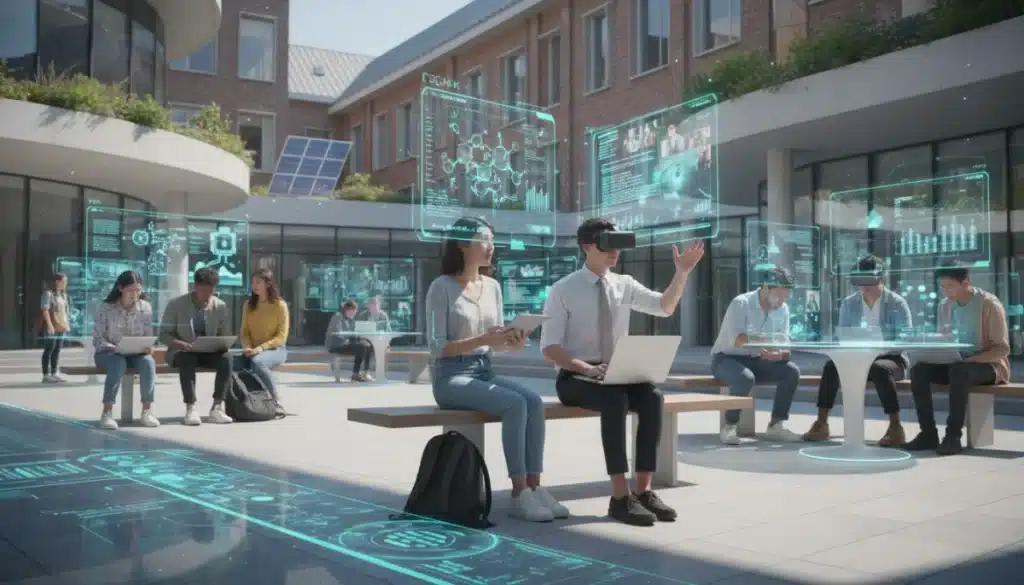
The future of online learning in US higher education by 2025 will be characterized by hyper-personalized experiences, AI-driven adaptive platforms, expanded global accessibility, and a greater emphasis on skill-based credentialing, reshaping traditional academic models.
The landscape of education is in constant flux, but few areas are experiencing transformation as rapidly as online learning. For US higher education, the next few years promise to be particularly dynamic. As we approach 2025, several key trends are converging to reshape how students learn, how institutions teach, and what qualifications mean in a competitive global market. Understanding these shifts is crucial for educators, policymakers, and students alike, as the very definition of a higher education experience continues to evolve. This article will delve into the future of online learning: 4 predictions for US higher education in 2025, offering a glimpse into the innovations and challenges that lie ahead.
The rise of hyper-personalized learning pathways
One of the most significant shifts we anticipate in online learning 2025 for US higher education is the widespread adoption of hyper-personalized learning pathways. Gone are the days of one-size-fits-all curricula; instead, technology will enable educational experiences tailored precisely to individual student needs, learning styles, and career aspirations. This move towards personalization is driven by advancements in artificial intelligence and data analytics, allowing platforms to adapt content and pace dynamically.
Imagine a system that understands not just what a student knows, but how they best absorb new information. This could involve recommending specific readings, interactive simulations, or collaborative projects based on past performance and stated preferences. The goal is to maximize engagement and comprehension, reducing attrition rates often associated with traditional online courses.
Adaptive learning technologies at the forefront
Adaptive learning systems, powered by sophisticated algorithms, will be central to this personalization. These technologies continuously assess student progress and adjust the learning path in real-time, providing targeted support where needed and accelerating through concepts already mastered. This ensures efficient learning, preventing both boredom and frustration.
- Dynamic content delivery: Materials will shift based on student interaction, ensuring relevance.
- Personalized feedback loops: AI will offer instant, constructive criticism on assignments and activities.
- Pacing flexibility: Students can move at their own speed, accommodating diverse schedules and commitments.
- Skill gap identification: Systems will pinpoint areas requiring additional focus, recommending resources.
Furthermore, institutions will leverage data to offer personalized academic advising, guiding students toward courses and programs that align with their strengths and future goals. This proactive approach to student success will be a hallmark of advanced online learning environments, fostering a more supportive and effective educational journey for every individual.
AI and automation in pedagogical design and delivery
Artificial intelligence and automation are not just buzzwords; they are becoming integral to the operational and pedagogical frameworks of online learning in US higher education. By 2025, AI will move beyond simple chatbots, integrating deeply into course design, content creation, and even assessment, freeing up educators to focus on higher-level mentoring and complex problem-solving. This revolution will streamline administrative tasks and enhance the learning experience in unprecedented ways.
Consider AI-powered tools that can analyze vast amounts of educational content to identify gaps or areas for improvement, or even generate preliminary course materials. This significantly reduces the burden on instructors, allowing them to dedicate more time to direct student interaction and innovative teaching strategies. The efficiency gained will be transformative for institutions facing budget constraints and increasing enrollment demands.
Intelligent tutoring systems and automated assessment
AI-driven intelligent tutoring systems will provide round-the-clock support, answering student queries, explaining complex concepts, and offering practice exercises. These systems learn from interactions, becoming more effective over time. Similarly, automated assessment tools will evolve to evaluate not just factual recall, but also critical thinking and analytical skills, providing immediate and objective feedback.
The integration of AI will also extend to creating accessible learning environments, automatically generating captions, transcripts, and even translating content for diverse student populations. This commitment to inclusivity will broaden access to higher education for many who previously faced significant barriers.
Expanded global access and cross-institutional collaboration
The digital nature of online learning inherently breaks down geographical barriers, and by 2025, US higher education will fully embrace this potential, leading to expanded global access and unprecedented cross-institutional collaborations. This trend will not only diversify student populations but also enrich the educational offerings available to all, fostering a truly global learning community. Institutions will increasingly look beyond national borders for both students and strategic partnerships.
Online platforms make it possible for students from anywhere in the world to access courses and degrees from prestigious American universities, without the need for relocation. This opens up new revenue streams for institutions and provides unparalleled educational opportunities for international learners. The ease of access will also facilitate micro-credentialing and specialized programs that cater to a global workforce.
Strategic partnerships for shared resources
Universities will form more strategic alliances, sharing resources, faculty expertise, and even jointly developed curricula. This collaboration can lead to more robust and diverse course offerings, allowing institutions to specialize while still providing a broad educational experience. Think of consortia offering interdisciplinary degrees that no single institution could provide alone.
- Joint degree programs: Collaborations will lead to new, innovative degree options.
- Faculty exchange platforms: Professors can teach across institutions globally.
- Shared digital libraries: Access to a wider range of academic resources.
- International research projects: Facilitating global collaboration in scholarship.
These partnerships will not only enhance academic quality but also foster a more interconnected and understanding global society. Students will gain exposure to diverse perspectives and cultures, preparing them for an increasingly globalized world. The future of online learning in US higher education is intrinsically linked to its global reach and collaborative spirit.
Focus on skill-based credentials and lifelong learning
As the job market continues its rapid evolution, a significant prediction for online learning 2025 in US higher education is a pronounced shift towards skill-based credentials and the promotion of lifelong learning. Traditional degrees will remain valuable, but employers are increasingly prioritizing demonstrable skills over just a diploma. Online education is uniquely positioned to deliver targeted, flexible, and rapidly updated skill acquisition programs.
This means a proliferation of micro-credentials, bootcamps, certifications, and stackable courses that allow individuals to acquire specific, in-demand skills quickly and efficiently. These shorter, focused programs cater to working professionals looking to upskill or reskill, as well as those seeking alternative pathways to career advancement without committing to a full degree program. The flexibility of online delivery makes these options highly accessible.
Micro-credentials and digital badges for career agility
Micro-credentials, often represented by digital badges, will become a common and recognized form of validating specific competencies. These credentials offer a transparent and verifiable record of acquired skills, making it easier for employers to assess candidates and for individuals to showcase their capabilities. This modular approach to learning supports continuous professional development throughout one’s career.
Universities will adapt by integrating these skill-based offerings into their core curricula, allowing students to earn both traditional degrees and specialized credentials simultaneously. This blended approach ensures graduates are not only broadly educated but also possess the precise skills needed to succeed in their chosen fields from day one. The emphasis will be on practical application and industry relevance.
Enhanced accessibility and inclusivity through technology
Another crucial prediction for the future of online learning in US higher education by 2025 revolves around significantly enhanced accessibility and inclusivity, largely driven by technological advancements. Online environments have the inherent potential to remove many traditional barriers to education, and institutions will increasingly leverage tools and best practices to ensure that learning is truly available to everyone, regardless of physical location, socio-economic status, or learning differences.
This commitment to accessibility goes beyond mere compliance; it’s about creating genuinely welcoming and effective learning spaces for all students. Technologies such as advanced captioning, audio descriptions, screen readers, and adaptive interfaces will become standard, not just optional add-ons. Furthermore, platforms will be designed with universal design principles in mind from the outset, ensuring usability for a diverse range of learners.

Addressing digital divides and financial barriers
While technology offers immense potential for inclusivity, addressing the persistent digital divide remains critical. By 2025, we anticipate more concerted efforts from institutions and policymakers to ensure equitable access to reliable internet and necessary devices. This might involve partnerships with telecommunication companies, community-based initiatives, or direct support programs for students in underserved areas.
- Affordable device programs: Universities may provide or subsidize laptops and tablets.
- Community Wi-Fi initiatives: Expanding internet access in rural and low-income areas.
- Flexible payment models: Offering varied tuition structures, including subscription-based learning.
- Open Educational Resources (OER): Widespread adoption of free, high-quality course materials to reduce costs.
Financial accessibility will also be a major focus. Online models can often reduce the overhead costs associated with traditional campuses, potentially leading to more affordable tuition rates. Additionally, the proliferation of micro-credentials and stackable programs allows students to invest in education incrementally, reducing the upfront financial burden and making higher education a more viable option for a broader demographic. This holistic approach ensures that enhanced accessibility is not just a promise but a tangible reality for a diverse student body.
Evolving faculty roles and professional development
The transformation of online learning 2025 in US higher education will inevitably lead to significant evolution in faculty roles and a greater emphasis on continuous professional development. As AI takes on more administrative and repetitive tasks, and as learning pathways become more personalized, the role of the educator will shift from primarily being a content deliverer to a facilitator, mentor, and expert guide. This change requires new skill sets and ongoing training.
Faculty will need to become adept at leveraging advanced learning technologies, interpreting data analytics to inform their teaching, and designing engaging, interactive online experiences. Their focus will increasingly be on fostering critical thinking, collaboration, and practical application of knowledge, rather than simply lecturing. The human element of mentorship and personalized support will become even more crucial in a technology-rich environment.
Continuous upskilling for effective online pedagogy
Universities will invest heavily in professional development programs designed to equip faculty with the necessary skills for this evolving landscape. This includes training in advanced pedagogical strategies for online environments, instructional design principles, and the ethical integration of AI tools. Faculty will also need to be proficient in fostering diverse and inclusive online communities.
The shift also implies a greater emphasis on faculty as designers of learning experiences, rather than just deliverers of content. They will collaborate more closely with instructional designers, technologists, and data scientists to create truly innovative and effective online courses. This interdisciplinary approach will be key to unlocking the full potential of digital education.
| Key Prediction | Brief Description |
|---|---|
| Hyper-Personalized Learning | Tailored educational pathways using AI and data, adapting to individual student needs and styles. |
| AI and Automation Integration | AI streamlines course design, content, and assessment, enhancing efficiency and freeing educators. |
| Global Access & Collaboration | Online learning expands international reach and fosters cross-institutional partnerships. |
| Skill-Based Credentials | Increased focus on micro-credentials and lifelong learning to meet evolving job market demands. |
Frequently asked questions about online learning’s future
AI will transform student-teacher interaction by automating routine tasks like grading and basic query responses. This allows educators to focus more on personalized mentorship, complex problem-solving, and fostering deeper critical thinking. Teachers will become facilitators, guiding students through AI-enhanced learning environments rather than just delivering content, leading to more meaningful engagements.
Traditional degrees will likely not become obsolete but will evolve. They will continue to provide foundational knowledge and critical thinking skills. However, the future will see traditional degrees complemented by skill-based micro-credentials and digital badges, which offer specific, verifiable competencies. This blend will create more agile and career-ready graduates, combining breadth of knowledge with targeted expertise.
Addressing the digital divide in online learning requires multi-faceted strategies. Institutions and policymakers will likely partner to provide affordable internet access and devices to underserved students. Initiatives like community Wi-Fi programs and subsidized hardware will be crucial. Additionally, designing low-bandwidth-friendly course materials can help ensure equitable access for all learners, regardless of their connection quality.
VR and AR are poised to revolutionize online learning by offering immersive and interactive experiences. They can simulate labs, historical sites, or complex scientific phenomena, allowing students to engage with content in ways traditional methods cannot. This will be particularly impactful in fields requiring hands-on experience, providing rich, experiential learning opportunities that enhance comprehension and retention.
Ensuring academic integrity in online learning by 2025 will involve a combination of advanced proctoring technologies, AI-driven plagiarism detection, and innovative assessment design. Focus will shift towards authentic assessments that require critical thinking and application, rather than mere recall, making cheating more difficult. Trust-based models and educational integrity policies will also play a crucial role in fostering ethical learning environments.
Conclusion
The trajectory of online learning 2025 in US higher education points towards a future that is more personalized, technologically advanced, globally connected, and acutely focused on practical skills. The predictions we’ve explored—hyper-personalized learning pathways, the deep integration of AI and automation, expanded global access through cross-institutional collaboration, and a strong emphasis on skill-based credentials—collectively paint a picture of an educational landscape undergoing profound and exciting transformation. These shifts are not merely incremental changes but represent a fundamental rethinking of how higher education can best serve a diverse student body in a rapidly changing world. Institutions that embrace these trends will be at the forefront of shaping the next generation of learners and leaders, ensuring that US higher education remains relevant, accessible, and impactful.