Optimize Your 2025 Benefits: HSAs and FSAs Maximized

Effectively optimizing your 2025 employee benefits, particularly Health Savings Accounts (HSAs) and Flexible Spending Accounts (FSAs), is crucial for maximizing healthcare savings and leveraging significant tax advantages, enhancing your overall financial well-being.
As you look ahead to the new year, understanding and strategically utilizing your employee benefits can significantly impact your financial health. Optimizing your 2025 employee benefits: maximizing Health Savings Accounts (HSAs) and Flexible Spending Accounts (FSAs) is not just about saving money; it’s about smart financial planning for your healthcare needs.
Understanding Health Savings Accounts (HSAs) for 2025
Health Savings Accounts (HSAs) continue to be a powerful tool for individuals enrolled in high-deductible health plans (HDHPs) to save and pay for qualified medical expenses. For 2025, it’s essential to grasp the updated contribution limits and how these accounts offer a triple tax advantage, making them a cornerstone of long-term healthcare savings.
An HSA offers a unique combination of tax benefits: contributions are tax-deductible, earnings grow tax-free, and withdrawals for qualified medical expenses are also tax-free. This trifecta makes HSAs an unparalleled savings vehicle, not just for immediate healthcare costs but also for future medical expenses, including those in retirement.
Eligibility and contribution limits
To be eligible for an HSA in 2025, you must be covered under an HDHP and not be enrolled in Medicare, nor be claimed as a dependent on someone else’s tax return. The IRS sets annual contribution limits, which typically increase each year. It is crucial to be aware of these limits to maximize your savings without incurring penalties.
- Self-only coverage: Understand the maximum amount you can contribute if you’re the only one covered by your HDHP.
- Family coverage: Note the higher limit for those covering themselves and at least one other family member under an HDHP.
- Catch-up contributions: Individuals aged 55 and older can make additional catch-up contributions, providing an extra boost to their savings as retirement approaches.
Staying informed about the specific 2025 limits, once announced, will be key to fully leveraging your HSA. Many employers also contribute to employee HSAs, further enhancing their value.
The triple tax advantage explained
The tax benefits of an HSA are often highlighted as its most attractive feature. Contributions reduce your taxable income, similar to a traditional IRA. The money you invest within your HSA grows tax-free, meaning you don’t pay taxes on interest, dividends, or capital gains. Finally, when you withdraw funds for eligible medical expenses, these withdrawals are also tax-free.
This makes an HSA not just a healthcare savings account but also a powerful retirement planning tool. Unspent HSA funds can be invested and continue to grow, providing a tax-free source of funds for medical costs in retirement, which can be substantial.
Understanding these intricate tax benefits allows individuals to make informed decisions about their healthcare spending and long-term financial planning, ensuring they are well-prepared for any medical contingencies.
Navigating Flexible Spending Accounts (FSAs) in 2025
Flexible Spending Accounts (FSAs) are another valuable employee benefit that allows you to set aside pre-tax money for healthcare or dependent care expenses. While similar to HSAs in their tax-advantaged nature, FSAs operate under different rules, particularly regarding the ‘use-it-or-lose-it’ principle, which needs careful consideration for 2025 planning.
FSAs are typically employer-sponsored and can be offered alongside any type of health plan, including those that are not high-deductible. This makes them accessible to a broader range of employees. The primary advantage is the tax savings on money used for eligible expenses, effectively reducing your overall taxable income.
Types of FSAs and their uses
There are two main types of FSAs: Healthcare FSAs and Dependent Care FSAs. Each serves a distinct purpose and has its own set of eligible expenses and contribution limits.
- Healthcare FSA: This account covers a wide range of medical, dental, and vision expenses for you, your spouse, and your dependents. This includes deductibles, co-payments, prescriptions, and various over-the-counter items.
- Dependent Care FSA (DCFSA): Designed to help with expenses for the care of qualifying dependents (children under 13 or incapacitated spouses/dependents) so you can work. This includes daycare, preschool, and elder care expenses.
Choosing the right type of FSA, or both, depends on your family’s specific needs and projected expenses for the upcoming year.
The ‘use-it-or-lose-it’ rule and exceptions
A critical difference between FSAs and HSAs is the ‘use-it-or-lose-it’ rule. Historically, any funds not used by the end of the plan year were forfeited. However, employers can now offer two exceptions:
- Grace period: An extension of up to 2.5 months after the plan year ends to use remaining funds.
- Carryover option: Allowing employees to carry over a limited amount of unused funds to the next plan year.
It’s vital to check with your employer about which, if any, of these exceptions they offer for 2025. This information will significantly influence how you plan your contributions and spending throughout the year. Careful estimation of your expected expenses is paramount to avoid forfeiting funds.
Effective management of your FSA involves a clear understanding of these rules and a proactive approach to spending down your balance before the deadline, ensuring you maximize this valuable benefit.
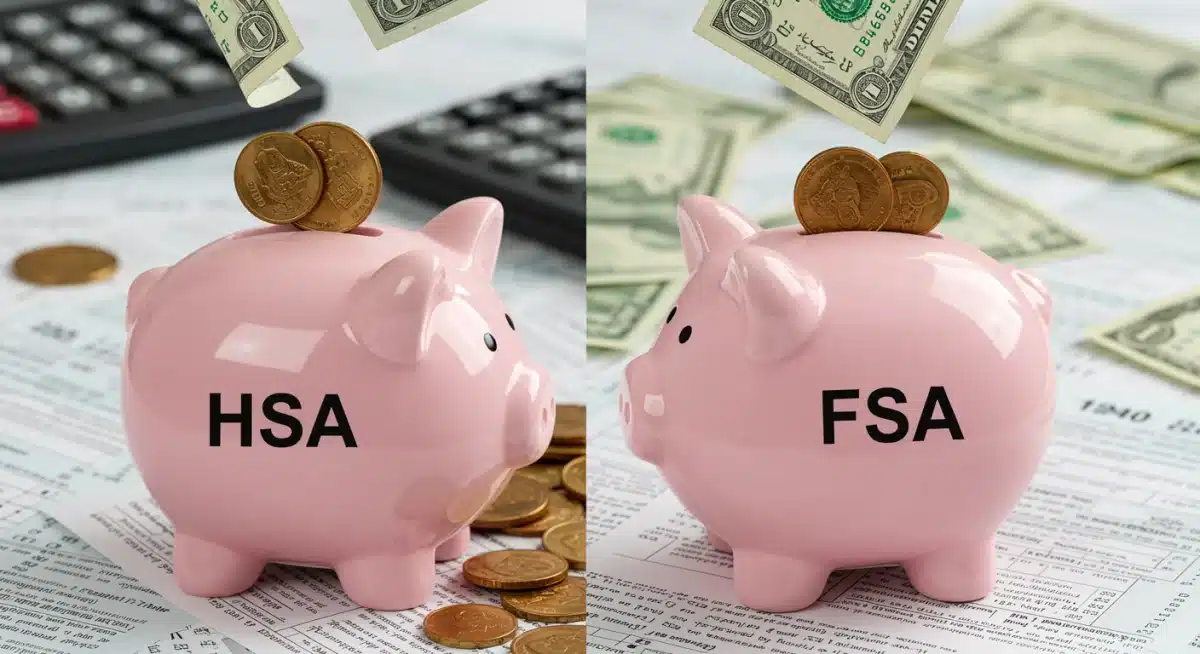

Key Differences and Synergies: HSA vs. FSA
While both HSAs and FSAs offer tax advantages for healthcare expenses, their fundamental differences dictate when and how each is best utilized. Understanding these distinctions is crucial for developing a comprehensive strategy to optimize your 2025 employee benefits.
The choice between an HSA and an FSA is not always mutually exclusive; in some scenarios, they can even complement each other. The primary factors to consider are your health plan type, your anticipated medical expenses, and your long-term financial goals.
Eligibility and portability
The most significant eligibility difference lies in the health plan requirement. An HSA mandates enrollment in a high-deductible health plan (HDHP), whereas an FSA can be paired with any health plan. This distinction immediately narrows down options for many individuals.
- HSA eligibility: Requires an HDHP, no Medicare, not a dependent.
- FSA eligibility: Available with most employer-sponsored health plans, regardless of deductible level.
- Portability: HSAs are portable; the account belongs to you, even if you change jobs or health plans. FSAs are generally not portable and are tied to your employer’s plan.
This portability factor makes HSAs particularly attractive for those who anticipate career changes or want a long-term savings vehicle.
Investment potential and long-term savings
HSAs offer investment opportunities, allowing your contributions to grow over time, tax-free. This investment potential is a game-changer for long-term healthcare planning, especially for retirement. FSAs, on the other hand, are strictly spending accounts; funds are not invested and typically do not roll over indefinitely.
The ability to invest HSA funds transforms them from mere spending accounts into powerful wealth-building tools. Many financial advisors even recommend maximizing HSA contributions before or alongside 401(k) contributions due to the triple tax advantage.
Strategically, if you qualify for an HSA and have the financial capacity, maximizing contributions can provide a significant boost to your retirement savings, specifically for healthcare costs, which are often a major concern for retirees.
Strategies for Maximizing Your HSA in 2025
To truly maximize your Health Savings Account in 2025, a proactive and informed approach is essential. This involves not only contributing the maximum allowable amount but also making smart decisions about how and when to use your funds, transforming your HSA into a powerful financial asset.
Thinking of your HSA as an investment vehicle, rather than just a checking account for medical bills, is the first step. The long-term growth potential, coupled with the tax advantages, can significantly enhance your financial security.
Contribute the maximum and invest wisely
The most straightforward strategy for maximizing your HSA is to contribute the full annual limit. If your employer offers contributions, ensure you take advantage of those as well. Once funds are in your HSA, consider investing them, especially if you have an emergency fund already established elsewhere.
- Automate contributions: Set up regular contributions to reach the annual maximum without thinking about it.
- Choose investment options: Many HSA providers offer a range of investment choices, from mutual funds to ETFs. Select options that align with your risk tolerance and financial goals.
- Avoid early withdrawals: Resist the temptation to withdraw funds for non-medical expenses, as these can incur taxes and penalties before age 65.
By treating your HSA as a long-term investment, you allow the power of compound interest to work in your favor, significantly increasing your account balance over time.
Pay out-of-pocket and save receipts
One of the most effective, yet often overlooked, strategies for maximizing an HSA is to pay for current medical expenses out-of-pocket and save your receipts. This allows your HSA funds to remain invested and continue growing tax-free.
You can then reimburse yourself for these past qualified medical expenses at any point in the future, even years or decades later. This strategy essentially turns your HSA into an emergency fund for future healthcare costs, or even a tax-free retirement income stream.
Maintaining meticulous records of all qualified medical expenses is crucial for this strategy. Digital record-keeping can simplify this process, ensuring you have access to documentation whenever you decide to reimburse yourself.
This method allows you to leverage the long-term growth of your HSA while still having the flexibility to tap into those funds for past expenses if needed, making it a highly versatile financial tool.
Optimizing Your FSA for 2025: Avoiding the ‘Use-It-or-Lose-It’ Trap
Effectively managing your Flexible Spending Account in 2025 requires careful planning to ensure you utilize all your allocated funds, thereby avoiding the dreaded ‘use-it-or-lose-it’ scenario. This involves accurately estimating your expenses and strategically spending down your balance.
The key to FSA optimization is proactive engagement throughout the year, rather than a last-minute scramble. By understanding your family’s healthcare and dependent care needs, you can make the most of this valuable pre-tax benefit.
Accurate expense estimation
The first step in FSA optimization is to accurately estimate your anticipated qualified expenses for the year. This requires reviewing your past medical, dental, vision, and dependent care costs, and anticipating any upcoming needs.
- Review past spending: Look at previous years’ medical bills, prescription costs, and dependent care invoices.
- Consider future needs: Factor in planned doctor visits, dental work, eyewear, or changes in dependent care arrangements.
- Include over-the-counter items: Remember that many over-the-counter medications and health products are FSA-eligible.
Padding your estimate slightly is often safer than underestimating, especially if your plan offers a carryover or grace period option. However, avoid over-contributing if your plan has a strict ‘use-it-or-lose-it’ policy without any flexibility.
Strategic spending and year-end planning
Once you’ve made your contributions, strategic spending throughout the year is vital. Don’t wait until the last minute to use your funds. Keep track of your balance and eligible expenses regularly.
Towards the end of the plan year, if you have a remaining balance, consider making planned purchases of eligible items. This could include stocking up on contact lenses, ordering new prescription glasses, or scheduling elective dental or vision procedures.
For Dependent Care FSAs, ensure you submit claims promptly for all eligible care costs. If you find yourself with an unexpected surplus, explore options for prepaying for services that fall within the plan year, if allowed by your provider.
By maintaining a proactive approach to both contribution and spending, you can fully leverage the tax benefits of your FSA and prevent any forfeiture of funds.
Combining HSAs and FSAs for Comprehensive Coverage
For some individuals and families, a strategic combination of both an HSA and an FSA can provide the most comprehensive and tax-efficient coverage for their healthcare and dependent care needs in 2025. This approach requires understanding how these accounts can coexist and complement each other.
While you cannot typically contribute to a Healthcare FSA and an HSA simultaneously for general medical expenses, there are specific scenarios and types of FSAs that can be combined with an HSA. This includes Limited Purpose FSAs and Dependent Care FSAs.
Limited Purpose FSAs with HSAs
A Limited Purpose FSA (LPFSA) is designed to work in conjunction with an HSA. An LPFSA only covers vision and dental expenses, freeing up your HSA funds to be used for general medical expenses or to be invested for long-term growth.
By utilizing an LPFSA for your predictable dental and vision costs, you can preserve your HSA balance, allowing it to accrue more interest and investment gains. This is an excellent strategy for those who have regular dental cleanings, orthodontics, or need new glasses or contact lenses annually.
The LPFSA still offers the pre-tax savings benefit for these specific categories of expenses, providing an additional layer of tax efficiency without conflicting with your HSA eligibility.
Dependent Care FSAs alongside HSAs
A Dependent Care FSA (DCFSA) is entirely separate from a Healthcare FSA and does not affect your eligibility for an HSA. This means you can contribute to both an HSA for medical expenses and a DCFSA for dependent care costs simultaneously.
This combination is particularly beneficial for families with young children or other qualifying dependents who incur significant care expenses. The DCFSA allows you to pay for daycare, after-school programs, or elder care with pre-tax dollars, significantly reducing the financial burden.
By using both an HSA and a DCFSA, you create a robust system for managing both your current healthcare expenses and your dependent care costs, all while enjoying substantial tax savings. This dual strategy can be a game-changer for family budgets in 2025.
Careful planning and a clear understanding of eligible expenses for each account will ensure you maximize the benefits of this powerful combination.
Future-Proofing Your Benefits: Long-Term Planning with HSAs and FSAs
Beyond immediate savings, smart utilization of HSAs and FSAs in 2025 should be part of a broader, long-term financial planning strategy. These accounts, particularly HSAs, offer opportunities to build wealth and secure your financial future, especially concerning healthcare costs in retirement.
Thinking strategically about how these benefits integrate with your overall financial goals can lead to significant advantages. It’s about viewing them not just as annual perks but as integral components of your financial well-being.
Retirement planning with your HSA
The HSA is often dubbed the ‘super IRA’ due to its triple tax advantage. After age 65, you can withdraw HSA funds for any purpose without penalty, though non-medical withdrawals will be taxed as ordinary income, similar to a traditional 401(k) or IRA. Withdrawals for qualified medical expenses remain tax-free.
This flexibility makes the HSA an excellent vehicle for retirement savings, especially since healthcare costs are a major concern for retirees. By maximizing contributions and investing wisely throughout your working career, you can build a substantial tax-free nest egg specifically for future medical needs.
Consider prioritizing HSA contributions if you are eligible, especially if you have already maximized other retirement accounts. The ability to pay for medical expenses tax-free in retirement is an invaluable benefit.
Adapting to evolving healthcare landscapes
The healthcare landscape is constantly evolving, with changes in costs, treatments, and insurance options. Staying informed about these changes and how they might impact your HSA and FSA strategies is crucial for long-term success.
Regularly review your health plan options during open enrollment periods. Assess whether an HDHP with an HSA continues to be the best fit for your family’s health needs and financial situation. Similarly, re-evaluate your FSA contributions annually based on projected changes in dependent care or medical expenses.
Being adaptable and proactive in reviewing your benefits ensures that you continue to make the most advantageous choices for your financial and health well-being, safeguarding your future against unforeseen changes.
| Key Point | Brief Description |
|---|---|
| HSA Triple Tax Advantage | Contributions are tax-deductible, earnings grow tax-free, and qualified withdrawals are tax-free. |
| FSA ‘Use-It-Or-Lose-It’ | Funds typically must be used by year-end, though grace periods or carryovers may apply depending on the employer. |
| HSA Investment Potential | HSAs can be invested for long-term growth, making them a powerful retirement savings tool for healthcare. |
| Combining Accounts | Limited Purpose FSAs and Dependent Care FSAs can be combined with HSAs for broader tax-advantaged coverage. |
Frequently Asked Questions About 2025 Benefits
While final IRS limits for 2025 are typically announced later in the year, they generally see an increase from the previous year. It’s crucial to monitor official IRS publications or consult with your benefits administrator for the exact, updated figures to maximize your contributions.
Generally, you cannot have a standard Healthcare FSA if you are enrolled in an HSA. However, you can have a Limited Purpose FSA (for dental/vision only) or a Dependent Care FSA alongside an HSA. This combination helps broaden your pre-tax savings.
Unused FSA funds are generally subject to the ‘use-it-or-lose-it’ rule. However, your employer may offer a grace period (up to 2.5 months) or allow a limited amount to be carried over to the next plan year. Check your specific plan details.
Yes, an HSA is an excellent retirement savings tool due to its triple tax advantage: tax-deductible contributions, tax-free growth, and tax-free withdrawals for qualified medical expenses. After age 65, funds can be withdrawn for any purpose, though non-medical withdrawals are taxed.
To avoid forfeiting FSA money, accurately estimate your annual expenses, regularly track your balance, and plan for year-end purchases of eligible items like contact lenses, prescription glasses, or dental procedures. Be aware of your plan’s grace period or carryover options.
Conclusion
Successfully optimizing your 2025 employee benefits: maximizing Health Savings Accounts (HSAs) and Flexible Spending Accounts (FSAs) is a critical component of sound financial planning. By understanding the unique features, benefits, and limitations of each account, you can make informed decisions that lead to significant tax savings and better management of your healthcare and dependent care expenses. Whether you’re leveraging the long-term investment potential of an HSA or strategically spending down your FSA to avoid forfeiture, proactive engagement with these benefits will undoubtedly enhance your financial well-being in the coming year and beyond. Take the time to review your options, consult with your benefits administrator, and integrate these powerful tools into your broader financial strategy.